




A good barbershop lighting plan must do more than make the room look stylish. It needs to help barbers judge fades, outlines, beard lines and hair colour accurately while keeping clients comfortable and making the shop inviting from the street. The most reliable approach is layered lighting: broad ambient light for circulation, stronger task light at each cutting station, balanced vertical light beside mirrors and softer accent light for reception and retail displays.
Quick answer: Start with approximately 300–500 lux for general barbershop circulation and 500–750 lux at cutting stations. Detailed colour work may benefit from 750–1,000 lux at the working area. Choose high-quality, low-flicker fixtures with a colour rendering index (CRI) of at least 90 for cutting and colour services, then verify the finished installation with a lux meter. Treat these figures as planning targets rather than guarantees because ceiling height, wall colour, fixture optics and layout all affect delivered light.
Recommended barbershop lighting levels by zone
Different parts of a shop perform different jobs, so one brightness level across the entire floor is rarely ideal. The table below provides practical starting points measured at the relevant work surface.
| Barbershop zone | Starting target | Design priority |
|---|---|---|
| Reception and waiting | 200–300 lux | Comfort, atmosphere and safe circulation |
| Retail display | 300–500 lux | Readable labels and attractive product presentation |
| Cutting and styling station | 500–750 lux | Even facial and head illumination with accurate colour |
| Hair colouring or precision work | 750–1,000 lux | High CRI and close visual inspection |
| Shampoo area | 200–300 lux | Relaxation, safe movement and easy cleaning |
| Back room and cleaning area | 300–500 lux | Visibility for storage, sanitation and maintenance |
More light is not automatically better. Excessive brightness can create glare in mirrors, fatigue staff and make an otherwise premium interior feel clinical. Uniformity matters: a station with a bright hotspot directly above the chair and dark areas around the face will be less useful than a slightly lower but balanced light level.
Use CRI to see hair and skin colour accurately
CRI describes how faithfully a light source renders colours compared with a reference source. A fixture with CRI 80 can be acceptable for corridors or storage, but cutting stations deserve CRI 90 or higher. High colour fidelity helps a barber distinguish subtle tone changes, blend a fade and evaluate hair colour without relying on daylight from a window.
When comparing fixtures, look beyond the headline CRI number. If colour services are important, ask for extended colour information such as R9, which relates to saturated red rendering. Consistency also matters: mixing lamps with visibly different colour quality or colour temperatures across adjacent stations can make the same client look different from one mirror to the next.
Choose a practical colour temperature
For most barbershops, neutral white light around 3500K–4000K is a versatile choice. It keeps the room crisp without the bluish cast that can occur at higher colour temperatures. A shop with warm timber and a hospitality-led atmosphere may use 3000K–3500K in reception, while retaining approximately 4000K at cutting stations for visual clarity.
Avoid mixing unrelated colour temperatures within the mirror’s field of view. Warm vertical mirror lights combined with a cool overhead fixture can produce uneven skin tones and confusing reflections. If the shop uses decorative warm light, keep it in the waiting, retail or feature zones and separate it from the primary task-lighting layer.

Plan overhead light for even coverage
Overhead lighting establishes the ambient layer and helps staff move safely through the shop. Distributed linear or geometric lighting can spread output over a larger ceiling area than a small number of point sources. This can reduce harsh pools of light and provide a distinctive ceiling feature at the same time.
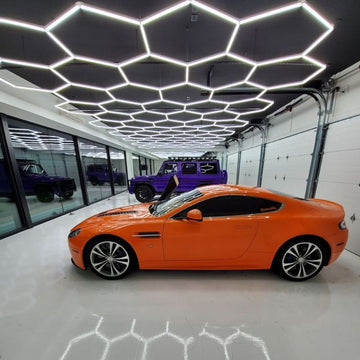
Hexagonal LED tube systems are especially useful when the illuminated geometry should reinforce the shop’s visual identity. The grid should be centred over the working zone rather than chosen only to fill the ceiling. Keep light over both the chair and the area where the barber stands, and check that sections are not blocked by ducts, ceiling fans or suspended signs. For broader product options, see HexaGara’s barbershop lighting collection.
Recessed downlights can supplement a grid, but narrow beams placed directly above a client often create pronounced eye-socket, nose and chin shadows. Track lighting is flexible for retail displays and feature walls, yet it should be aimed carefully so clients do not see bright sources reflected in mirrors.
Light mirrors from the sides to reduce facial shadows
Mirror lighting is the most important task layer. Overhead light alone illuminates the top of the head well but can leave the face, beard and lower sides of the haircut darker. Vertical fixtures installed on both sides of the mirror bring light toward the face from useful angles and help balance those shadows.

Use diffused sources rather than exposed high-intensity diodes. Mount both sides symmetrically and keep the light near the mirror’s vertical edges so it reaches the client without shining directly into their eyes. A horizontal light above the mirror can add fill, but it should not replace the two-sided arrangement at a station where beard and facial work is common.
Mirrors multiply glare. Before final installation, sit in the client position and stand where the barber works. Look for reflected bright points, veiling reflections across the face and distracting views of ceiling fixtures. Dimming the task and ambient layers separately makes it easier to balance the room after furniture and mirrors are installed.
Control glare, flicker and contrast
Glare is not simply an issue of total brightness. Exposed light sources, high contrast between a bright ceiling and dark walls, and poorly aimed spotlights can all cause discomfort. Choose diffusers where possible, distribute output across several fixtures and use matte finishes near the mirror rather than highly reflective metal surfaces.
Flicker can cause fatigue and may produce bands or pulsing in social-media videos. Ask suppliers for flicker performance rather than assuming every LED system is suitable for cameras. If the shop regularly records haircuts, test fixtures at the frame rates and shutter settings used by the team before ordering the entire installation.
Dark interiors absorb more light than white ones. A black ceiling, charcoal walls and dark cabinetry may require more fixture output to achieve the same measured lux as a pale room. That does not mean flooding the shop with light: it means planning the fixture count, distribution and controls around the actual finishes.
Divide the shop into lighting zones
Separate controls make a barbershop more flexible. Cutting stations can stay bright during service while waiting and shampoo areas remain softer. Retail shelving benefits from focused accent light, and a window display may need additional daytime output to compete with outdoor brightness.

A useful control plan might include one circuit for general ceiling lighting, one for mirror lights, one for retail or feature lighting and one for shampoo and back-room areas. Compatible dimming gives the shop flexibility for cleaning, normal appointments, photography and after-hours ambience. Occupancy sensors can be helpful in staff rooms and storage areas, but automatic shutoff should not interrupt an active cutting station.
Worked layout: a four-chair barbershop
Consider a rectangular 1,000 sq. ft. shop with reception and retail at the entrance, four cutting stations along one wall, two shampoo basins at the rear and a small storage room. Begin with an ambient target of about 300 lux across circulation areas. Position a distributed ceiling system over the cutting zone and open floor, then provide a pair of vertical diffused lights at each mirror.
At the stations, aim initially for 500–750 lux measured around head height and on the working plane, not only on the floor. Use higher-CRI task lighting at every mirror and keep the colour temperature consistent. Add adjustable accent fixtures for retail shelves and use softer lighting at the shampoo area. Place these layers on separate controls.
After installation, measure each chair with the furniture, mirrors and finishes in place. Check readings at multiple points around the head position because one central measurement can hide dark sides. Ask a barber to perform a visual check on different hair and skin tones. Re-aim, dim or supplement fixtures where the measurements and real working experience reveal unevenness.
How to estimate fixture output
Lux is lumens per square metre, but total fixture lumens do not translate directly into a guaranteed lux value at the chair. Some emitted light is lost because of beam distribution, mounting height, dark surfaces and spacing. Photometric data or a lighting calculation is the best way to predict performance in a new build.
For an early estimate, calculate the area of each zone, choose a target lux and multiply the two to find the lumens that would need to reach that plane. Then allow for utilization and maintenance losses instead of treating the result as the exact fixture output to buy. Large rooms, high ceilings or dark finishes deserve a professional layout. The same calculation principles used in our garage lighting calculation guide apply, but the barbershop must also account for mirrors and vertical illumination.
Installation and safety considerations
Confirm the voltage, power-feed limits, dimmer compatibility and maximum connected run for every modular system. Large geometric layouts may need more than one power feed. Drivers and connections must remain accessible as required, and ceiling attachment points must support the fixture configuration.
Choose products suitable for the environment and verify applicable safety certifications for the complete product configuration. Certification does not by itself establish brightness, CRI, flicker performance or service life. Electrical work should follow local code and manufacturer instructions; hardwired circuits and new controls should be installed by a qualified electrician where required.
Plan maintenance access before mounting fixtures above fixed cabinetry or wash basins. Keep replacement specifications and driver information with the shop records. Clean diffusers and reflective surfaces periodically, since dust and aerosol products can gradually reduce useful output.
Barbershop lighting checklist
- Set a target lux range for every zone.
- Use CRI 90+ at cutting and colour stations.
- Keep task-light colour temperature consistent.
- Combine distributed overhead light with two-sided mirror lighting.
- Check mirror reflections from client and barber positions.
- Choose diffused, low-glare and low-flicker fixtures.
- Separate ambient, mirror, retail and shampoo controls.
- Verify electrical loads, dimming and installation requirements.
- Measure the completed shop and adjust the layout.
Frequently asked questions
What colour temperature is best for a barbershop?
Neutral white around 3500K–4000K works well for most shops. It supports clear visual work without feeling as cool as higher-temperature light. Decorative areas can be warmer, but keep cutting-station lighting consistent.
How bright should a barber station be?
Use 500–750 lux as a practical starting range at the station. Precision colour work may benefit from 750–1,000 lux. Measure at the actual working area after installation and prioritize uniformity over a single high reading.
Is CRI 80 enough for cutting hair?
CRI 80 may be adequate for general circulation, but CRI 90 or higher is a better choice at mirrors where accurate hair and skin colour matters.
Can hexagon lights be the only lighting in a barbershop?
A well-designed ceiling grid can provide the primary ambient layer, but mirror-side lighting is still valuable because overhead light alone can leave facial and beard areas in shadow. Retail, reception and shampoo zones may also need separate layers.
Should barbershop lights be dimmable?
Dimming is useful for balancing task and ambient light, adapting the shop for photography or events and creating a softer atmosphere after service hours. Confirm that drivers and controls are mutually compatible.
How do I prevent glare in barbershop mirrors?
Use diffused sources, avoid aiming narrow beams toward mirrors, control brightness contrast and inspect reflections from both client and barber viewpoints. Separate dimming for ceiling and mirror lights makes final balancing easier.
Thoughtful barbershop lighting combines measurable performance with a strong visual identity. Start with the work: clear colour, controlled shadows and comfortable visibility. Then use ceiling geometry, accent lighting and zoning to shape the atmosphere around it. Explore HexaGara barbershop lighting for fixture ideas suited to cutting stations and contemporary shop interiors.
