
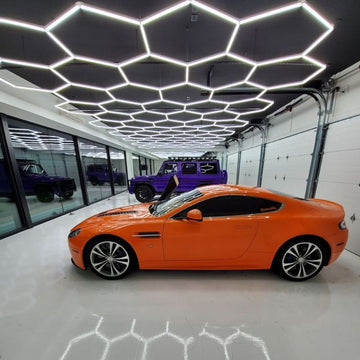







Color temperature decides whether a room feels warm and relaxing or bright and alert. It is measured in kelvins (K), running from about 2700K (warm and yellowish) up to 6500K (cool, daylight-like). Get it right and a space looks intentional; get it wrong and an office feels gloomy or a bedroom feels like a clinic. Here is how the ranges work, the best pick for each space, and how tunable LED lights let you change the look whenever you want.
Key takeaways
- Color temperature is measured in kelvins: 2700K–3000K is warm, 3500K–4500K is neutral, 5000K–6500K is cool/daylight.
- Use warm light for living and rest areas, neutral for kitchens and bathrooms, and cool for garages, workshops, gyms, and offices.
- Color temperature changes only how light looks, not your energy bill, that depends on wattage and efficiency.
- Tunable (CCT-adjustable) LED fixtures cover warm, neutral, and cool in one light, so a single room can shift with the task or time of day.
What is color temperature?
Color temperature describes the hue of the light a bulb gives off, measured in kelvins (K). Lower numbers around 2700K–3000K look warm and yellowish, like a traditional incandescent bulb. Higher numbers from 5000K and up look cool and blue-white, close to midday daylight. It is purely about appearance, not how bright the light is.
The three color temperature ranges
Most lighting falls into three practical bands. Warm white sets a relaxed mood, neutral white keeps things clear and natural, and cool white drives focus and visibility. Here is a quick reference you can match to any room.
| Range | Appearance | Best for |
|---|---|---|
| 2700K–3000K (Warm white) | Soft, cozy, yellowish | Living rooms, bedrooms, lounges |
| 3500K–4500K (Neutral white) | Balanced, natural | Kitchens, bathrooms, offices |
| 5000K–6500K (Cool white / daylight) | Bright, crisp, blue-white | Garages, workshops, gyms, studios |
Best color temperature for each space
The right temperature depends on what you do in the room. Match the light to the task and the mood you want.
- Home offices: neutral white (3500K–4500K) reduces eye strain while keeping you alert and productive.
- Gyms and fitness spaces: cool white (5000K–6500K) energizes the room and keeps equipment clearly visible. See our best gym lighting design guide for layouts.
- Garages and workshops: cool white shows true colors for detailed work. Pair it with the right brightness from our garage lighting guide.
- Living and rest areas: warm white (2700K–3000K) makes a space feel calm and inviting.
How color temperature affects mood and productivity
Color temperature changes how a space feels, not just how it looks. Warmer tones encourage relaxation and wind-down, which is why they suit bedrooms and lounges. Cooler tones support alertness and concentration, so they work in offices, garages, and gyms. Choosing the right band for each room improves both comfort and how well you get things done in it.
Tunable LED lights: one fixture, every color temperature
One of the biggest advantages of modern LED lighting is tunable, or CCT-adjustable, white. A single fixture can switch between warm, neutral, and cool, so the same room can be cozy in the evening and crisp during focused work. Hexagonal LED lights give you this flexibility, which means you do not have to commit to one color temperature for a multi-use space.
Color temperature vs. brightness and CRI
Three specs get mixed up, so it helps to separate them. Color temperature (K) is the warm-to-cool look. Brightness is measured in lumens, and it controls how much light you actually get. Color Rendering Index (CRI) measures how accurately colors appear under the light, on a 0–100 scale. For detail-heavy work you want both a cool temperature and a high CRI, which we cover in our guide to high-CRI lighting. Picking a color temperature does not change your energy use, that comes down to wattage and efficiency (lumens per watt).
How to choose the right color temperature
A few quick questions make the choice easy:
- What happens in the room? Relaxing, working, or both. That points you to warm, cool, or tunable.
- How much daylight does it get? Darker rooms benefit from cooler light to mimic daylight, while bright rooms can take warmer or neutral tones.
- Can you layer it? Combine overhead hexagonal lights with warmer accent lighting to balance function and comfort.
Conclusion
The right color temperature turns a space from merely lit into genuinely comfortable and functional. Warm tones for relaxation, neutral for everyday clarity, cool for focus and detail, and tunable LEDs when you want all three. Hexagonal LED lights give you the full range, so you can match every room to the way you actually use it.

