
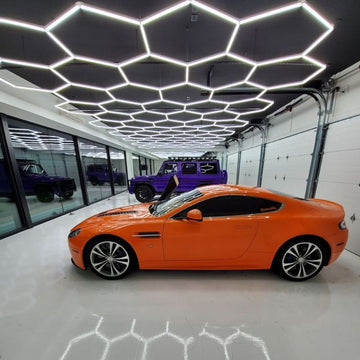



Hexagonal lights are six-sided LED fixtures that you mount in modular, honeycomb-style patterns to light a space evenly while doubling as a design feature. They have moved from a niche gaming-room look to a practical choice for garages, gyms, salons, and workshops because they spread light with fewer shadows and scale to almost any ceiling. This guide covers what they are, how they work, where they shine, and how to choose the right set.
Key takeaways
- Hexagonal lights are modular LED panels that connect into honeycomb layouts for even, low-shadow coverage.
- They suit garages, gyms, salons, barbershops, workshops, and retail, and scale from a single hex to large grids.
- LED hex lights are energy efficient and come in different brightness levels and color temperatures.
- When buying, check brightness (lumens), color temperature, size, and safety certifications like UL or CSA.
What are hexagonal lights?
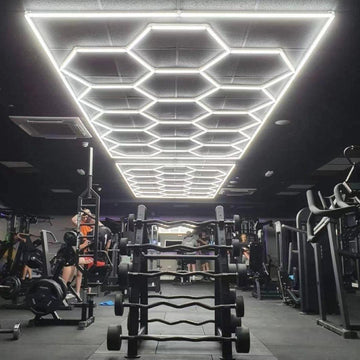
Hexagonal lights are six-sided LED light panels designed to be linked together, usually in a honeycomb pattern. Each hex is a self-contained fixture, and you combine as many as you need to cover a wall or ceiling. The shape is not just for looks: tiling hexagons leaves no awkward gaps, so light spreads more evenly than a few separate fixtures would. The result is a bright, modern surface that works as both lighting and a visual centerpiece.
How hexagonal lights work
Most hexagonal lights are modular and connectable. You mount the units and link them so they run from a single power source, then expand the grid over time if you want more coverage. Because the light comes from a wide LED surface rather than a single bulb, it is diffuse and easy on the eyes, which helps reduce the harsh shadows you get from one central fixture. Many sets also offer adjustable brightness and color temperature, so one installation can flex between tasks.
Where hexagonal lights work best
The even coverage and modular layout make hex lights a strong fit for spaces that need bright, shadow-free light over a large area.
- Garages and car detailing shops: broad, low-shadow coverage for detail work. See the garage lighting guide.
- Gyms and high-ceiling spaces: even distribution across big, open rooms. See best gym lighting design.
- Barbershops and salons: focused, flattering light for precision work plus a modern look.
- Warehouses and retail: efficient coverage of large commercial floors.
Key features and benefits
Two features make hexagonal LED lights stand out for everyday use. First, energy efficiency: LED technology draws far less power than traditional fixtures, so running costs stay low while output stays high, more on this in our guide to the energy efficiency of hexagonal LED lights. Second, customization: hex lights come in a range of brightness levels, color temperatures, and layouts, and many support tunable white or RGB so you can match the mood and the task.
How to choose the right hexagonal lights
Match the lights to your space with four checks:
- Brightness (lumens): size the total output to the room and how detailed the work is, then split it across enough fixtures for even coverage.
- Color temperature: cool white (5000K–6500K) for garages, gyms, and workshops; warmer tones for relaxed spaces. See the color temperature guide.
- Size and layout: plan the grid for the wall or ceiling, leaving room to expand later.
- Certifications: choose lights with genuine safety certification so they meet electrical and performance standards. See certifications for hexagonal lights.
Conclusion
Hexagonal lights pair a modern, modular design with practical, even illumination, which is why they have spread from feature walls to garages, gyms, and shops. Get the brightness, color temperature, size, and certifications right, and a hex layout gives you reliable, low-shadow light that also looks the part. Start small and expand the grid as your space and needs grow.

